
Diploma of Counselling: AIPC
Member of Australian Counselling Association
National Police Check Certificate
DCSI Working with Children Screening
Trauma Informed Principles Training
Counselling can be a powerful way to navigate difficult periods in life, or to better understand why things feel the way they do.
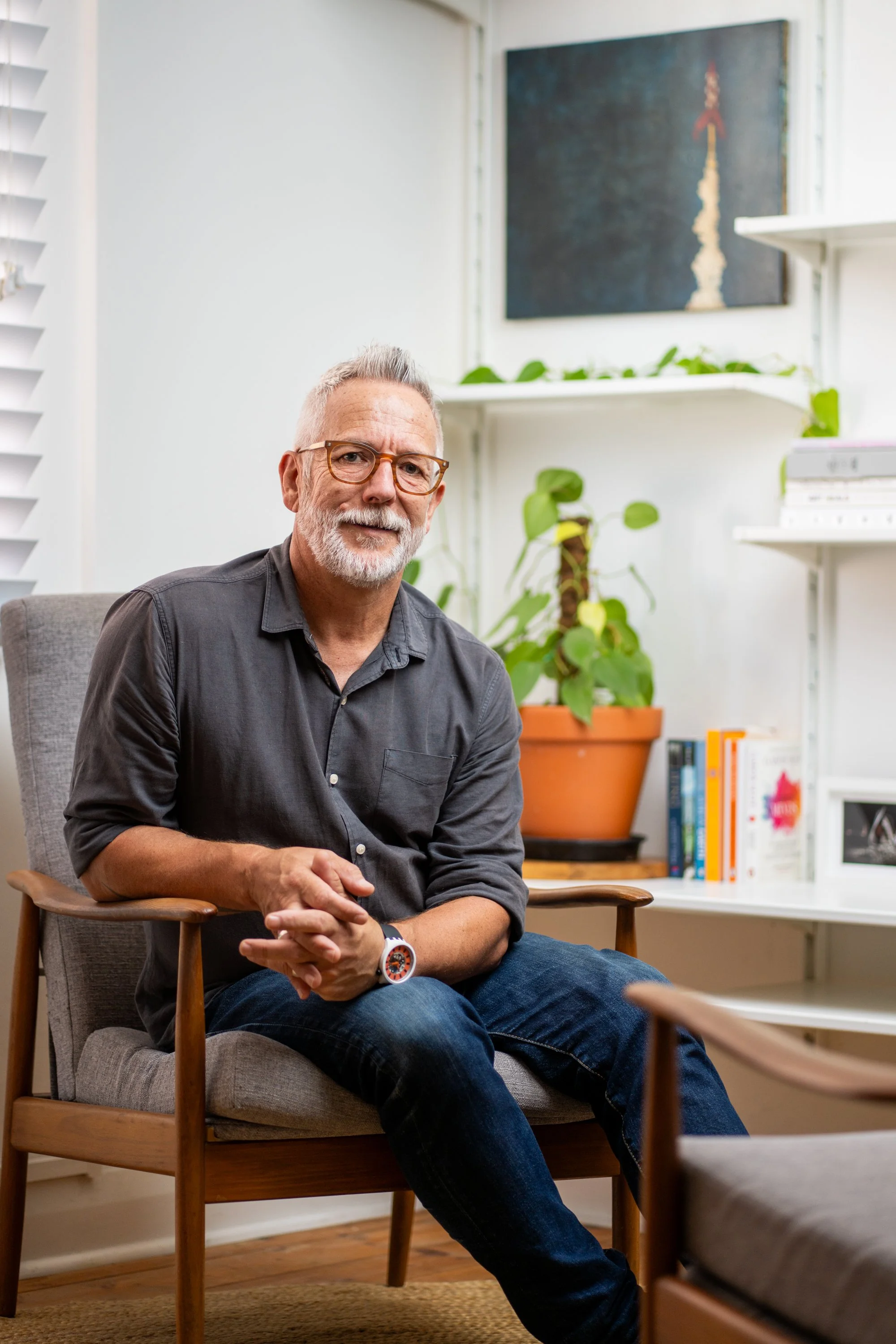
I came to this work later in life. I’m 54, and my path here has taken me through both the corporate world and a long-standing creative practice. Across those experiences, and in working with many different people, I’ve come to see that while our lives may look very different on the surface, many of the challenges we face are shared.
My own experiences of seeking support at different times in my life played a significant role in my decision to train as a counsellor. They gave me a clear understanding of how important it is to feel heard, respected, and safe in that space.
I offer a calm, considered environment where you can speak openly, without pressure or judgement. Whether we meet in person, online, or in more remote settings, the aim is the same, to create a space where we can work together towards a greater sense of clarity and peace.
I also have a strong interest in the needs of regional communities. This developed through earlier work creating a series of films exploring mental health in those areas. I’m committed to working in regional Australia, both independently and alongside existing providers where appropriate.
I am part of the Urban Wellness Collective at 16 Nile Street, Port Adelaide, and offer sessions via Zoom.
FREQUENTLY ASKED QUESTIONS
-
Person-centred counselling is based on the idea that you are the expert on your own life. Rather than giving advice or telling you what to do, I work alongside you to explore what’s going on, help you make sense of it, and support you in finding your own way forward.
It’s a collaborative process, built on trust, honesty, and feeling safe enough to speak openly. Over time, this often leads to greater clarity, self-awareness, and the ability to make changes that feel right for you.
-
Not in a direct sense. My role isn’t to give instructions or solutions, but to help you better understand yourself and your situation so you can make decisions that feel right for you.
That said, I do work in a practical way. We can explore tools, patterns, and strategies together. It’s not passive, it’s just not directive.
-
Anything.
Some people come with something very specific, others aren’t quite sure where to begin. You don’t need to have it all worked out. We can start wherever you are and take it from there.
-
Yes, absolutely.
Sessions can be accessed from anywhere, including overseas. The booking system manages time zones, making it easy to schedule sessions wherever you are. When you look at the booking calendar, you will see a late night, and the occasional weekend, this will adjust as demand from out side Australia develops.
As long as you have a stable internet connection and a private space, online counselling can work well.
-
Yes, for many people they are.
Online sessions via Zoom can be a very effective way to connect. Some people find it easier to speak openly from their own space, without needing to travel or be in an unfamiliar environment.
The core of counselling is the quality of the conversation and the relationship, and that can translate well online.
-
Sessions are conducted using a secure, widely used platform.
As with any online communication, there are some privacy limitations. You can support your privacy by using a secure connection and being in a private space.
-
You don’t need to decide that perfectly in advance.
Often the best way to know is to come to a first session and see how it feels. There’s no obligation to continue if it doesn’t feel like the right fit.
-
The first session is a little longer, around 90 minutes.
This gives us time to properly understand what’s bringing you in, your background, and what you’re hoping to get from counselling. It also gives you space to get a feel for how I work and whether it feels like a good fit.
There’s no pressure to cover everything. It’s simply a starting point.
-
Ongoing sessions are typically 60 minutes.
-
There isn’t a fixed answer. Some people come weekly for a period of time, others prefer to space sessions out.
We can talk about what feels right for you and adjust as we go. There’s no requirement to commit to a set number of sessions.
Many people find it helpful to begin with more regular sessions, then space them out over time.
-
Each session costs $120. The first session runs for approximately 75 minutes, allowing time to properly understand your situation and what you’re looking for from counselling.
Ongoing sessions are 60 minutes.
Payment is made at the time of booking, unless prior arrangements have been made.
If additional work is requested, such as reports or extended communication, this may be charged at a pro-rata rate.
-
If you need to cancel or reschedule, please provide at least 24 hours’ notice.
Late cancellations or missed appointments may be charged the full session fee. This helps keep the practice sustainable and allows that time to be offered to others.
If you arrive late, sessions will still finish at the scheduled time.
-
I’m not able to provide ongoing support outside of scheduled sessions, and I’m not an emergency service.
If you need urgent help, it’s important to contact a crisis support service or emergency services.
-
You are free to stop counselling at any time.
If possible, it can be helpful to have a final session to reflect on the work we’ve done, but this is entirely your choice.
If I feel that counselling is no longer the most appropriate support, I will discuss this with you and may suggest other options.
-
If at any point something feels uncomfortable or unclear, you’re encouraged to raise it.
Counselling works best when there is openness on both sides, and we can talk through anything that comes up.
-
If it becomes clear that your needs would be better supported by another service, I will talk this through with you and help guide you toward appropriate options.
-
Yes. What you share in counselling is treated with care and respect, and your privacy is protected.
This includes not only what is discussed in sessions, but also the fact that you are attending counselling.
There are some legal limits to confidentiality. These include situations where there is a risk of harm to yourself or someone else, where a child may be at risk, or where information is required by law.
If any of these situations arise, I will always aim to discuss this with you openly where possible.
-
As part of professional practice, I may engage in supervision.
This means I may discuss aspects of my work with an experienced supervisor to ensure I am providing the best possible support. These discussions are conducted in a way that does not identify you.
-
I keep brief notes to support the counselling process and ensure continuity between sessions.
These are stored securely using professional systems that meet privacy and data protection standards.
-
Records are kept for a minimum period required by law, typically at least seven years from your last session. In some cases, records may need to be retained for longer.
-
You have the right to request access to the records I keep about you. If you would like to do this, we can talk through the process.
-
I use a secure, AI-assisted tool within my practice system to support note-taking. This allows me to stay present in the session while maintaining accurate records.
No audio recordings are stored
Information is encrypted and securely stored
Your data is not used to train AI models
-
Yes. You can choose not to have AI-assisted note-taking used during your sessions, and you can change this preference at any time.